The Shift That’s Happening Right Under Your Nose
I need to tell you something that might sting a little.
You’re still using AI like it’s 2024. You open ChatGPT and ask it to write an email, generate a social caption, or summarize some meeting notes. Then you close the tab and get back to what you consider “real work.”
Meanwhile, your smartest competitors stopped using AI to have conversations months ago. They started giving it actual jobs.
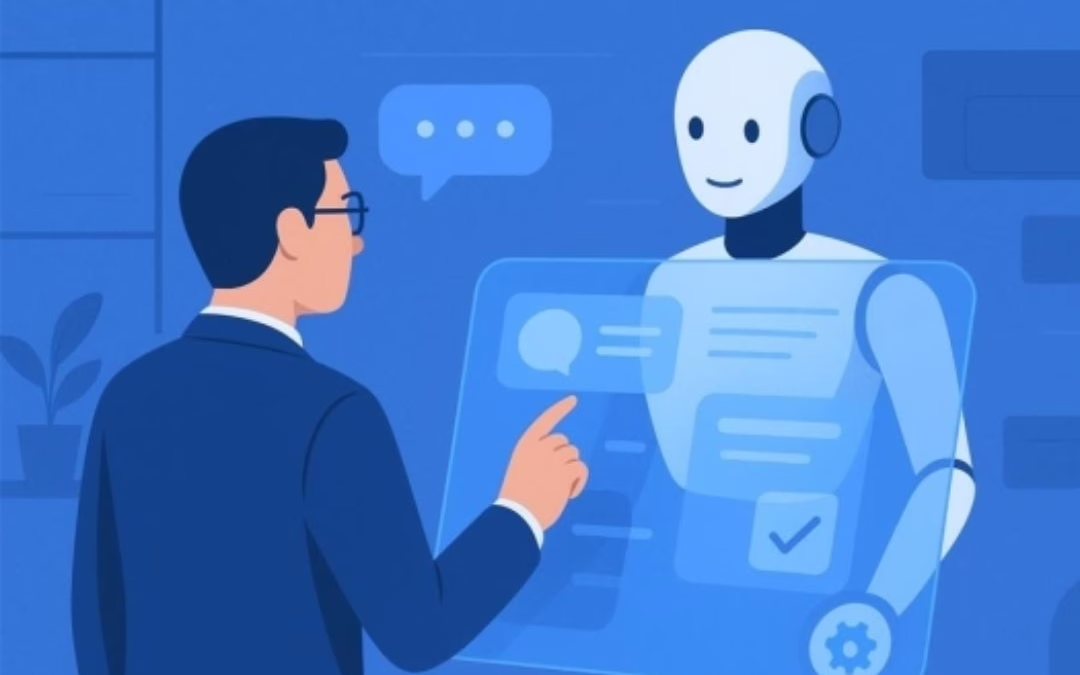
The language around this stuff has changed. We’re not talking about “AI assistants” anymore. The term everyone’s using now is “AI agents,” and the difference isn’t just semantic. An assistant gives you a recipe when you ask for one. An agent goes into your kitchen, cooks the meal, cleans up, and texts you when dinner’s ready.
I know that sounds like hype. But it’s not. This is actually happening.
According to recent research, 71% of small businesses are using AI in some capacity. But here’s the part that matters: 57% of those same businesses admit they’re stuck in “experimentation mode.” They’re dabbling. Testing tools. Collecting bookmarks. Not actually changing how they operate.
And the gap between the dabblers and the adopters? It’s getting wider every week.
This post is about closing that gap. I’m going to show you how AI agents are transforming small businesses right now—not in some hypothetical future—and give you the exact prompts to deploy your first agents this week.
Let’s go.
The 3 AI Agent Superpowers Transforming Small Business in 2026
1. The Autonomous Operations Agent: Your 24/7 Business Manager
Remember when “automation” meant scheduling social posts in Hootsuite? That’s not what we’re talking about here.
AI agents in 2026 are running entire business functions without supervision. They monitor your operations, spot problems, and fix them before you even know something went wrong. You’re not giving them instructions every morning—they’re already working by the time you wake up.
Why does this matter? Because you’ve been the bottleneck. Every decision waits for you. Every problem needs your attention. AI agents break that cycle.
The data supports this: 78.6% of small businesses using AI agents report reduced costs or improved efficiency. We’re seeing autonomous customer service agents handling inquiries around the clock, inventory agents that predict stockouts and reorder automatically, and financial agents that flag weird spending patterns and suggest fixes.
Here’s a prompt you can actually use:
Autonomous Operations Agent Prompt:
You are my Autonomous Operations Agent. Your job is to monitor my business daily and proactively identify opportunities and problems.
Here’s my business context:
– Business type: [e.g., “E-commerce selling sustainable home goods”]
– Current monthly revenue: [e.g., “$25K”]
– Team size: [e.g., “Just me + 2 part-time contractors”]
– Biggest operational headache: [e.g., “Customer support emails overwhelming me”]
Your daily responsibilities:
- Review yesterday’s performance data (sales, customer inquiries, website traffic) and identify 3 patterns or anomalies I should know about.
- Suggest 2 specific operational improvements I can implement this week based on those patterns.
- Flag any customer service issues that need immediate attention and draft responses.
- Identify one task I’m doing manually that could be automated, and outline exactly how to automate it.
- Predict next week’s biggest operational challenge and give me a mitigation plan.
Deliver this as a daily briefing I can read in 3 minutes. Be specific, not generic. Use data, not hunches.
What you get: A business partner that never sleeps, never misses patterns, and turns chaos into clarity every morning.
2. The Multi-Agent Marketing Team: Your Coordinated Growth Engine
This is where things get interesting.
The most sophisticated small businesses in 2026 aren’t deploying one AI agent. They’re running teams of specialized agents that coordinate with each other. One researches your competitors. Another analyzes your customer data. A third creates content. A fourth optimizes ad spend. They communicate, share insights, and execute complete campaigns together.
It sounds complicated, but think about it this way: You’ve been trying to be the strategist, the analyst, the copywriter, the media buyer, AND the project manager. That’s why you’re exhausted. Multi-agent systems let you orchestrate specialists instead of doing everything yourself.
Companies using AI-driven customer data strategies are seeing 2.4x higher revenue growth. The reason? AI agents can analyze customer patterns at scale and at speeds that are impossible for humans, and then act on those insights across every channel simultaneously.
Here’s how to deploy your own marketing team:
Multi-Agent Marketing Team Prompt:
You are my Multi-Agent Marketing Coordinator. I need you to simulate a team of specialist agents working together on a campaign.
Campaign Goal: [e.g., “Launch a Valentine’s Day promotion to increase sales by 20%”]
My Current Assets:
– Customer data: [e.g., “1,200 email subscribers, purchase history for past 6 months”]
– Top-selling products: [e.g., “Handmade candles, sustainable kitchenware”]
– Budget: [e.g., “$500 for ads”]
– Time to execute: [e.g., “10 days”]
Activate these specialized agents:
Agent 1 – Customer Insight Analyst:
Analyze my customer purchase patterns and identify the 3 customer segments most likely to buy during Valentine’s Day. For each segment, define their motivations and preferred messaging.
Agent 2 – Competitive Intelligence Specialist:
Research what 3-5 competitors in my space are doing for Valentine’s promotions. Identify gaps in their approach that I can exploit.
Agent 3 – Campaign Strategist:
Based on Agents 1 & 2 insights, design a complete campaign strategy: offer structure, messaging angles, channel mix, and timeline.
Agent 4 – Content Creator:
Write 3 email subject lines, 3 email body variations, 5 social media posts, and 2 ad headlines—all tailored to the strategy from Agent 3.
Agent 5 – Budget Optimizer:
Allocate my $500 budget across channels (email, social ads, influencer partnerships) to maximize ROI based on my audience insights.
Deliver this as a comprehensive campaign brief with clear hand-offs between agents. Show me how they built on each other’s work.
What you get: A coordinated marketing operation that thinks strategically, acts tactically, and delivers results that look like you have a full agency behind you.
3. The Strategic Decision-Making Agent: Your Data-Powered Board Advisor
This is the biggest shift in how people are using AI in 2026.
Stop asking AI to answer questions. Start using it to ask better questions and challenge your assumptions.
The best AI agents don’t just execute tasks—they think with you. They pressure-test your strategy, force you to confront blind spots, and make you reconsider things you thought you knew.
You make strategic decisions every week based on gut feeling, limited data, and whatever worked last quarter. AI agents can analyze patterns across your entire business, compare your approach to industry trends, simulate different scenarios, and tell you what you’re not seeing.
PwC’s research shows that businesses using AI for strategic decision-making—with proper benchmarks and metrics—are seeing real P&L impact. The difference isn’t speed. It’s using AI to redesign workflows and challenge thinking, not just accelerate existing processes.
Strategic Decision-Making Agent Prompt:
You are my Strategic Decision-Making Agent and Board Advisor. Your job is to challenge my thinking and help me make better strategic choices.
Here’s my current strategic question:
[e.g., “Should I expand into wholesale partnerships or focus on growing my DTC e-commerce channel?”]
My Business Context:
– Current revenue split: [e.g., “100% DTC, $30K/month”]
– Profit margins: [e.g., “45% on DTC sales”]
– Customer acquisition cost: [e.g., “$25 per customer”]
– Average order value: [e.g., “$85”]
– My gut instinct: [e.g., “I want to pursue wholesale because it feels like ‘real growth'”]
Your Strategic Analysis:
- CHALLENGE MY ASSUMPTIONS:
What assumptions am I making about this decision that might be wrong? What am I not considering?
- SCENARIO MODELING:
Model 3 scenarios for the next 12 months:
- a) Status quo (keep doing DTC)
- b) Pursue wholesale aggressively
- c) Hybrid approach
For each project, revenue, profit, time investment, and risk level.
- BLIND SPOT IDENTIFICATION:
Based on industry data for businesses like mine, what are the 3 biggest pitfalls I’m likely to encounter with each path?
- CONTRARIAN PERSPECTIVE:
Play devil’s advocate. If you were advising me to do the OPPOSITE of what my gut says, what would your argument be?
- DECISION FRAMEWORK:
Give me a clear decision framework with specific criteria and thresholds. What metrics or conditions would have to be true to make each option the right choice?
- NEXT BEST ACTIONS:
If I’m still uncertain, what are 3 small tests I can run in the next 30 days to gather real data before making this decision?
Be brutally honest. I don’t need you to agree with me. I need you to help me think clearly.
What you get: A strategic thinking partner that forces clarity, surfaces hidden risks, and helps you make decisions with your brain instead of your gut.
Why This Matters More Than You Think
Look, I just gave you three AI agent prompts. Three workflows. Three ways to start delegating real work instead of just asking questions.
These will get you results. They’ll prove that AI agents can be your workforce, not just your word processor. They’ll show you this isn’t hype.
But here’s what I’m not going to do: pretend like three prompts are enough to run your entire business.
What happens when you need an AI sales agent that qualifies leads while you sleep? A content production agent that turns one article into 50 pieces of content? A customer retention agent that predicts churn before it happens? An HR agent who screens resumes? A financial forecasting agent that models different scenarios?
You could figure all of that out over the next six months through trial and error. Or you could get the complete system today.
That’s why we created The Ultimate Guide to Using AI to Run Your Business: 87 Practical Solutions.
It’s your complete AI agent playbook. Every prompt is battle-tested. Every workflow is organized by business function—operations, marketing, sales, finance, team management, and strategy. You get multi-agent frameworks, implementation guides, and real business scenarios (not generic corporate examples).
The whole thing is built for business owners who want results without needing a computer science degree.
The price is $14. That’s it. Less than what you’d spend on lunch.
We’re raising the price soon, so if you’re going to grab it, do it now.
Get the complete AI agent playbook here →
One Last Thing
February 2026 will be remembered as the moment AI agents became unavoidable for small businesses.
The companies winning right now aren’t the ones with the biggest budgets or the most technical expertise. They’re the ones who stopped experimenting and started executing.
You’ve seen the shift in this post. You know AI agents exist. You know they work. You have three prompts you can use today.
The only question is whether you’re actually going to use them.
Six months from now, you’ll look back on this moment. You’ll either think, “That’s when everything changed for my business,” or you’ll think, “I wish I’d acted sooner.”
Your call.
Let’s Talk: Where Are You on the AI Journey?
I’m curious where you’re at right now.
Which of these three AI agent types would have the biggest impact on your business? Is the operations agent running things 24/7? Is the marketing team coordinating campaigns? Is the strategic advisor is challenging your thinking?
And be honest: Are you still experimenting with AI, or have you actually integrated it into your operations?
Most small business owners are stuck in experimentation mode. There’s no shame in that. But knowing where you are is the first step to breaking through.
One more question: If you could hand off ONE complete business function to an AI agent tomorrow—no limits—what would it be? Customer service? Content? Financial analysis? Lead gen?
Drop your answer in the comments. I read all of them, and your feedback shapes what we build next.